
The economy of Nigeria is a lower-middle-income, mixed economy and emerging market[26][27] with expanding manufacturing, financial, service, communications, technology, and entertainment sectors.[28][29] It is ranked as the 52nd-largest economy in the world in terms of nominal GDP, the second largest in Africa in terms of purchasing power parity, and the 19th-largest in terms of purchasing power parity.
The country’s re-emergent manufacturing sector became the largest on the continent in 2013, and it produces a large proportion of goods and services for the region of West Africa.[30] Nigeria’s debt-to-GDP ratio was 36.63% in 2021 according to the IMF.[20]
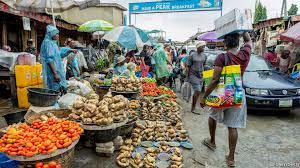
Although oil revenues contributed 2/3 of state revenues,[31] oil only contributes about 9% to the GDP. Nigeria produces about 2.7% of the world’s oil supply. Although the petroleum sector is important, as Nigeria’s government revenues still heavily rely on this sector, it remains a small part of the country’s overall economy. The largely subsistence agricultural sector has not kept up with the country’s rapid population growth. Nigeria was once a large net exporter of food, but currently imports some of its food products. Mechanization has led to a resurgence in the manufacturing and exporting of food products, and there was consequently a move towards food sufficiency.[32] In 2006, Nigeria came to an agreement with the Paris Club to buy back the bulk of its owed debts from them, in exchange for a cash payment of roughly US$12 billion.[33]
According to a report by Citigroup, published in February 2011, Nigeria had the highest projected average GDP growth in the world between 2010 and 2050.[34][35] Nigeria is one of two countries from Africa among the 11 Global Growth Generators countries.[36]